Thank You and Good Night
After nearly four decades in Sacramento, comedian Jack Gallagher quietly left town in 2024 and moved back to his native Massachusetts to be near family. In his latest (and last) one-man show at the B Street Theatre, he talks about what he left behind as he bids a fond farewell.


An Irish goodbye refers to the act of leaving a party quietly, without telling people. What inspired you to choose that term for the title of your new one-man show?
Well, my wife Jean Ellen and I moved from California back to Massachusetts, to Cape Cod, in June of ’24. We grew up on the South Shore of Boston, near Plymouth. But we’ve been coming to Cape Cod since ’90. We love it. We were either going to stay in Sacramento or move back East, and we decided to move back East. We have very big families. I’m one of five kids—there are three of us left. Jean Ellen is one of seven, and there are six of them left. And with the exception of her sister, Mary K, who lives in Oakland, they’re all [on the East Coast], within an hour of us.
We had been in Sacramento for 37 years, and I didn’t want to spend eight months saying goodbye to people. We didn’t tell anyone we were going to leave, with the exception of a couple of close friends. I didn’t want to run into people, say goodbye, and then run into them again: “Hey, I thought you were leaving!” So yeah, that’s the reason I called it An Irish Goodbye.
The show is about our kids in the house, our neighborhood, all the memories there, and packing up the house and leaving Sacramento. It was really, really hard to leave Sacramento. We moved there in ’87. I had only been doing stand-up for about five or six years. So I was at the beginning of my career. Both our boys came home from the hospital to the house that we had on 3rd Avenue in Land Park. We established roots there. You live in a place for almost four decades, and it becomes your home. It was emotional driving away for the last time.
Many Sacramentans may be surprised to learn you moved to Cape Cod, especially given that you still hosted your annual musical comedy show in Sacramento last April, and now you’re back with An Irish Goodbye at the B Street Theatre. Do you see yourself continuing to perform in Sacramento every year or so?
No. I’ll come back to Sacramento, but I probably won’t work. This is it.
A lot of people will be even more surprised to learn that.
Never say never. But at this point, this is the last show I write. This is the ninth one. I’ve got nothing else to write about. I’ve written about my sons, I’ve written about my dad, I’ve written about my love of music. I’ve written about my stand-up career. And I’m 72 years old. This is the end. I’m done after this. No more.

Jack Gallagher returns to the B Street stage this March with An Irish Goodbye, his ninth one-man show. (Portrait by Jay Gavron, courtesy of Jack Gallagher)
Your last one-man stage show, 2019’s A Stand Up Guy, looked back at your 40-year career as a stand-up comedian (which included appearances on The Tonight Show and Late Night with Conan O’Brien). When we talked to you about that production, you said, “I can see the journey, and it seemed interesting.” Looking back now at your nearly 40 years in Sacramento, what were some of the most interesting moments in that journey?
The stuff I learned how to do. I moved to Sacramento from L.A. to work at Channel 3. They hired me to host TV Lite, an ill-fated afternoon variety talk show. Worst name for a television show ever created. I had never hosted anything. My TV experience had been [performing on] The Tonight Show. I did a guest spot on Cheers. At the time, Bob Wisehart was the entertainment critic for the Bee, he reviewed the show and said my interviewing style was like someone trying to park a bus in a compact car space. I didn’t know what I was doing. So I learned. I learned how to work with live cameras. I learned how to read a teleprompter, which is a really hard thing to do and not look like you’re reading a teleprompter. I learned how to interview people.
It got canceled [after nine months], and David Mering, who owned a big advertising company in Sacramento, hired me to start doing commercials. I’d never done commercials. I’d never done voiceovers. So I had to learn. Then I started working for PBS and I had these incredible opportunities that now, looking back, I think, “Wow.” I hosted a couple of different shows for PBS [Money Moves, Off-Limits and Kids, Cash and Common Sense]. That was the most interesting stuff, work-wise.
More interesting than work was being a dad, raising two boys [Declan who is now 34, and Liam who is now 30], and everything that comes with that. We stayed in Sacramento because we thought it would be a good place to raise our kids. We liked L.A., but everybody’s in the same business. The whole town is show business, and it’s very competitive. Somebody’s always doing better than you, and somebody’s always doing worse than you. We moved to Sacramento and our friends were carpenters and doctors and accountants and lawyers, and everybody did something different.
You moved from Boston to L.A. in 1983 to break into entertainment. And although TV Lite was short-lived, you still had a busy on-screen career while living in Sacramento, not just with PBS, but including your own network sitcom, ABC’s Bringing Up Jack in 1995, and a recurring role on Curb Your Enthusiasm. Would you often fly down to L.A.?
When the show got canceled at Channel 3, I was still out on the road doing stand-up in nightclubs, and I could fly out of Sacramento just as easily as I could fly out of Burbank. For the first couple years, I would go down [to L.A.] during pilot season—January, February—and I would do auditions. When I did Bringing Up Jack, I would be down there Monday through Friday, and be home Saturday and Sunday. That was a very interesting experience. By the time I was doing Curb, the boys were older and I would just fly back and forth.
When TV Lite ended, it was like, “Should we move back to L.A.? You want to move back to Massachusetts?” We had just bought the house in Land Park and we said, “No, let’s stay here and see what happens.” I feel like, “Wow, we really wound up in the right place.” It just fit. It fit us really well.
I had friends come up all the time, especially when I was doing TV Lite. I would call comedian friends in L.A. and say, “Hey, come up and do my show. Stay at the house, we’ll go to dinner.” When I moved to Sacramento, they all said, “You’re going to kill your career. What are you doing in Sacramento?” And without exception, every time someone came up … I remember specifically, one of my good buddies who I started in Boston with, the comedian Steven Wright. The first time he flew in, he said, “It’s really beautiful up here.” I said, “Yeah, I know.” He had flown over the rice paddies and said, “Wow. And the trees. It’s just gorgeous!”
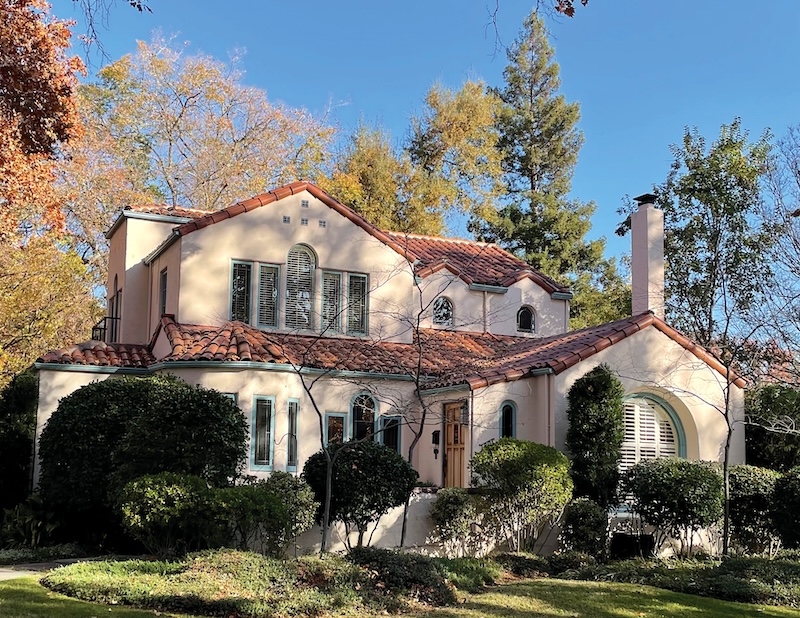
The Gallagher family home in Land Park (Photo by Jean Ellen Dunn Gallagher)
You’re best known, at least locally, for your personal one-man shows. Your inaugural show, Letters to Declan, which chronicled your days as a first-time father, premiered in 1993. It also marked the beginning of your partnership with B Street, which has staged all of them. How did the relationship come about?
The comedy club thing blew up in the ’80s, but I could see that was starting to end. People had started writing one-person monologues. I don’t call them plays, because my idea of a play is six or seven actors. I do monologues. Whoopi Goldberg had written one. And there was a club owner, Mark Anderson, who kept saying to me, “Write a one-man. Write a one-man.” He owned a bunch of improv comedy clubs, which were the cream of the crop. And he owned one in San Francisco at the corner of Mason and Geary. He said, “If you write a one-man show, I’ll give you the club in San Francisco for a month.” So that meant I could be off the road for a month, which was unheard of. But I didn’t know what I was going to write about.
Declan’s birth [in 1991] was fairly traumatic. When he came out, he wasn’t breathing. So as a result, I started writing him letters, thinking maybe we won’t have the amount of time I thought we would as he’s growing up for me to tell them everything that a dad is supposed to tell their kids. Then I was talking to Jean Ellen and I said, “Maybe I could use these letters as a way to structure a show.” So I did that.
The month in San Francisco [in 1993] turned into five months. I did it for two months in Washington, D.C. It was very successful. I got the sitcom out of it—the sitcom came from that. That failed rather dramatically [Bringing Up Jack was canceled after five episodes], and I was looking around. B Street was fairly new, and I got in touch with [its co-founder] Buck Busfield, and I said, “I have this thing. I’d like you to look at it.”
I went to the old B Street place [at 28th and B streets, where the B Street Theatre was located until its move to The Sofia complex in midtown in 2018]. He sat in the audience, just him, and he said, “Do the show.” When I was done, he gave me a couple notes, and said, “Do you want to do that here?” And then that was it.
I consider myself pretty lucky, because I fell in with B Street, didn’t want to travel anymore, and they would just call me and say, “You have an idea for something?” They allowed me to be home and not be on the road while the boys were growing up, which is a huge plus. I owe B Street a lot.
Fast-forward to today, and you’ve co-written your past two one-man shows, A Stand Up Guy and An Irish Goodbye, with Declan. [In 2010, Gallagher wrote and performed A Different Kind of Cool, which focused on Liam, who has autism.] It feels like a full-circle moment. What prompted you to start writing together, and what is it like writing with your son?
We had talked about writing a show for the two of us, doing a two-man thing. Then when I started to think about doing A Stand Up Guy, I was trying to figure out the throughline of that show, and I was talking to him about it. He said, “Well, you could talk about your television experiences, you could tell stories about good shit that happened, and bad shit that happened.” And I said, “Do you want to write this with me?”
He’s very funny and clever, and he gets the joke. You can write a line, and you know that there should be a joke there. He knows where the joke is, and that is not easy to do. Declan was living in New York. He now lives in Liverpool. He met a guy. They fell in love. They moved to Liverpool and got married in April. He writes breaking news and movie reviews for a couple different magazines. He’s always been a good writer, and I’ve always liked his writing.
The way he explains it is, he knows my voice. I’ll write, and then I’ll send it to him, he’ll read it, and we’ll talk on the phone for a couple hours and make edits—he’ll punch it up or he won’t. It’s very easy to write with him and take criticism from him. He’ll say to me, “I don’t think that’s funny. Delete it,” which is what I need. I think everything I write is gold. Then I do it on stage, and people go, “Was he supposed to be funny?”

Gallagher with his son Declan, who co-wrote An Irish Goodbye with him (Photo by Jean Ellen Dunn Gallagher)
Has writing about your personal memories changed your relationship or your perspective on each other?
You know, when I wrote Letters to Declan, he was 2. He’s 34 [now]. A lot has happened in those years. But he has never seen Letters to Declan. He doesn’t want to see it. And he had not read the section about him in the [new] play until yesterday. We did a read-through. With these things, I’m pretty honest, and he didn’t say anything.
It’s nothing terrible. It’s just stories about him. But Declan’s a wiseass. I’m telling a couple of funny stories about that. And we had a couple of years where it was pretty rough. He didn’t like me, and I always loved him, but he drove me crazy. I wouldn’t say our relationship was contentious, but I was really visible in Sacramento, and people thought they knew him because of me. When he was 10, 11, 12, we’d see people and they’d say, “Oh, you’re the famous Declan.” He didn’t like that.
I think what surprised me the most was how protective he is of me. In Stand Up Guy, I tell a story about doing The Tonight Show. My first shot, I did really, really, well. The second time, I didn’t. Declan said, “Don’t talk about that. People don’t need to know that you didn’t do well the second time.” I think he wants to see me shown in the best possible light. And my thing is, always tell the truth.
What’s interesting is, in your relationship with your kids, you’re the dad. And people always say, “You can’t be their friend and be their father,” right? Which is true. You’ve got to put the hammer down sometimes. Then Declan moved to New York, and I really missed him. I was heartbroken that he was gone, and we started to talk, and then he became my friend. And now he’s my friend, in addition to being my son, and our relationship changed. A lot of it was through this process, even before we were writing together, we were just hanging out and talking. So writing with him is really easy for me.
Honest to God, the best thing I’ve ever done in my life is these two boys, without a doubt. And having the ability to write with Declan is one of the great joys of my life.
With this likely being your last one-man show, and your last time performing in Sacramento, what are your thoughts going into it?
When you’re young, you’re looking forward. What’s the next thing? When you get to be my age, all of a sudden you start looking back and going, “I had a network sitcom. I was on The Tonight Show with Johnny Carson.” And—OK, so this is not even a humble brag—I won three Emmy Awards, three years in a row for best on-camera talent in the San Francisco-Sacramento market. Did I enjoy those? No, I wanted a fourth. Now I look back and go, “That’s pretty cool that that happened.” And that’s how I feel about Sacramento. I feel like we wound up in the right place.
We watched Sacramento change considerably. I do a joke that you didn’t go downtown after 5 o’clock in 1987. They didn’t want you going downtown, which is why they put the [old Arco] sports arena in the middle of an empty field on the way to the airport. Then we saw it turn into what it is now—there are great restaurants, stores, a lot of theater, an art scene.
The show is running from March 11 through April 5. What will be your first stops once you’re back in town? What do you miss?
I miss being there. I had a neighbor across the street from me, Craig, who a lot of mornings would sit out on his front porch and play his guitar. I used to wake up to that and think, “I love this.”
Living in Land Park, I loved going to Taylor’s Market or Marie’s Donuts or Freeport Bakery. I loved riding my bike down to the Delta. We lived so close to Marie’s Donuts, we could smell them making the donuts at night from our house. I miss the apple fritters at Marie’s Donuts. They’re the best apple fritters in the world. I love going to Waterboy and OneSpeed, [chef-owner] Rick Mahan’s places. I love oysters and they always have good oysters at Waterboy. At One Speed, the pizza and pasta are always good.
I’ll tell you what else I miss: The best sushi in Sacramento is at Oto’s market. If you’ve never tried it, this guy, Ray [Yamamoto, the sushi chef], is in the back of the supermarket. It is the best. No bullshit. It’s straight-on traditional. I don’t like the fusion stuff, the jalapeños on it or whatever. Jean Ellen and I always say, “Oh, God. We miss Ray’s [sushi].” We would order so much—basic stuff like California rolls, dragon rolls, rainbow rolls, spider rolls. So I’m definitely doing that. I can’t say enough about it.
Greta Gerwig has called Lady Bird her love letter to Sacramento. Would it be fair to say that An Irish Goodbye is your farewell letter to Sacramento?
Yes, it very much is. It’s a goodbye letter saying thank you. I’m grateful for the way that people let me live my life without always being in the public eye. I’m grateful that we got to raise our family there, we got to live in a great neighborhood, in a great house with great neighbors and in a town that was really nice.
Sacramento was good to my family. It became our home. They accepted me for who I am, they accepted Jean Ellen, they accepted the boys, and they liked my work. I’m eternally grateful for that.
This interview has been edited for length, flow and clarity.