G-Man
After 40 years as the definitive voice of the Sacramento Kings, Gary Gerould has been our man in the arena—our steadfast guide through the many ups and downs of a franchise trying to find its way. And now, at 85, he’s the second longest-serving active announcer in the NBA. Marking this milestone anniversary, we turned the mic on the broadcasting legend and, as ever, G-Man hit nothing but net.

Portrait by Max Whittaker, microphone photo by Marty Biniasz
I If Gary Gerould is more closely associated with the history of the Sacramento Kings than any other single figure, it may be because his 40-year run as the club’s play-by-play announcer embodies every facet of the Kings’ collective experience. Like many of us, he has hoped and dreamed, and suffered and grieved. With the exception of brief absences to fulfill national broadcasting assignments, the 85-year-old Gerould has seen all the good—and too much of the bad—of the team’s California tenure.
Gerould has been the steady drumbeat accompanying the four decades that have followed the Kings’ 1985 premiere in old Arco Arena I—the first of three buildings the franchise has called home in Sacramento. (In fact, at 40 years, he’s tied for second among the longest-serving active broadcasters in the NBA.) His scholarly preparation for games (he still carries a folder full of notes for each matchup that takes him hours to compile) has paid off in a sterling reputation among both fans and fellow broadcasters. Kings listeners know Gerould—aka G-Man—as the voice they trust.
What listeners may not know is that off the court, Gerould—a native of Midland, Michigan; population 10,329 when he was born in 1940—has lived a life in full, with tremendous highs and traumatic lows.
He has interviewed everyone from Diana Ross to Evel Knievel. He went to Japan in 1985 to cover sumo wrestling alongside Isleton-born Karate Kid star Pat Morita and to South Korea to report on the 1988 Seoul Olympics. Racing legend Mario Andretti even once took him out for a 180-mph spin at the 1999 Target Grand Prix of Chicago event.
But he has also faced profound challenges. Gerould lost his father to cancer when he was only 12, and with his mother subsequently battling health issues, he often spent nights as a boy with other family, neighbors and members of the local church congregation. The family that he built with his wife, Marlene, has experienced heartache as well, including the 2020 death of their daughter Beth. (The couple’s son, Bob Gerould—known to most as Bobby—runs the basketball analytics site Hoop Obsession and lives in Rocklin.) And earlier this year, the family made the difficult decision to move Marlene, who has battled deteriorating health for years, into an assisted living facility near the Greenhaven house she and Gary bought in 1971, where Gary still lives today.

Gary Gerould at his home office in Greenhaven on Sept. 4, 2025. (Portrait by Max Whittaker)
When the subject of raising their family arises, Gerould immediately salutes his wife of 64 years, whom he met when they were students at Anderson College in Indiana. “The credit goes to Marlene,” he says, leaning forward in a chair in his living room. “She was the rock in the situation. You’re on the road for 41 games out of every regular NBA season, and then I was doing motorsports stuff and the other things that related to the network assignments as a freelancer. So I was on the road virtually all the time. Marlene was the one who was here and being Mom and Dad to Bob and Beth.”
These days, Gerould keeps things simple. He regularly plays golf, often with longtime friend and noted local golf journalist Frank LaRosa. He spends time with his family, visiting Marlene nearly every day when he’s not traveling to broadcast his 41st season with the Kings.
In an expansive interview at his home in late August, Gerould reflected on a career built on excellence and amplified by the vagaries of sports—and life.


How did you get started with play-by-play?
The first year after I graduated from college, I couldn’t find a job in broadcasting. But then WMDN, the local radio station back in my hometown, called saying, “We heard from another station that you’re looking for work. You’ve got a spot here if you want it.” [Gerould previously hosted a weekly sports program at WMDN when he was in high school and worked there during summer breaks in college.] So Marlene and I went back to Midland, Michigan. It was football season, and Friday night football in the state of Michigan is a pretty big thing. We had a really good high school football team—we won a state championship.
One Friday night, I’m just in the booth hanging out with the sports director, who’s calling the game, and the station manager, who doubled as the engineer. For whatever reason, still unknown to me to this day, at halftime, the sports director, Art, went out for a smoke or whatever, and he never came back. And you know, I’m wondering, where’s Art? And the third quarter’s getting close to starting, and the station manager looked at me and he said, “I guess you’ll be calling the second half.” No preparation, nothing other than a single page that had names and numbers on it. And so that’s how my official play-by-play career began.
Did you ever find out what happened to that man?
Never did. I just know that he got fired. Nobody ever told me anything. I just knew that the next Friday night, I was the guy, and I finished out the football season.

A teenage Gerould at the mic for Michigan radio station WMDN in the late 1950s. (Courtesy of Anderson University)
You were 22 years old at that point, so let’s get you from Michigan to California. How did that happen?
My father-in-law was a minister in Chico, and once a month or so, he would go into the radio station [KHSL] and he would record a lead-in or a lead-out to religious programming that they did on Sundays to maintain their FCC license. One day in 1963, my father-in-law was in there. The program director—Don Baroda—said, “Preacher! I just had to fire so-and-so. What am I gonna do?” And my father-in-law calmly said, “Well, I have a son-in-law who’s involved in radio in Michigan.” “Preacher! Get him on the phone right now.” And two weeks later, Marlene and I and Beth, who was an infant, were headed from Midland, Michigan, to Chico, California.
A couple of years later, you made the move to Sacramento to do sports on television for KCRA.
What was Sacramento like in 1965?
I didn’t have any preconceived notions. The Kelly brothers [Jon and Bob Kelly], who owned Channel 3 at that time, took great pride in the slogan “Where the News Comes First.” And it absolutely did. There was no budget. It was just whatever it took to do the job.
So, my immediate perception of Sacramento had to be shaped. And one of the things that just bugged the heck out of me was that there was this “think small” mentality. I’m thinking, this is a wonderful place. Then the thing that really began to change a lot of that thinking was the arrival of the Kings, [the vision of] Gregg Lukenbill and the other original owners of the Sacramento Kings.
You’ve been with the Kings as its radio play-by-play announcer since day one. But joining the team actually involved you being let go from KCRA in 1977 after more than a decade at the station.
It was a very difficult time. The owners got involved with a consulting firm based in Iowa, and as I understand it, the consulting firm decided that I wasn’t flashy enough. That led to the administrative powers at Channel 3 making a decision to fire me. It was hard, especially with a young family; we had two kids. You don’t know how you’re going to pay your bills and support them. We sat down basically as a family unit, even though the kids were small, and said, “We’re going to make this the best thing that’s ever happened to us.” Didn’t have a clue as to how. I tried looking for jobs in San Diego, Oakland, San Francisco and Los Angeles. Nothing available.
But one of KCRA’s owners wound up opening a new door for you, right?
Bob Kelly told me, “There’s a new show that’s going to be created out of NBC Sports based in New York called Sportsworld, and I think that you would be good for that.” And he gave me the contact information for Don Ohlmeyer [who was executive producer of NBC Sports at the time], and every weekday morning, I would get up, place a call to Don Ohlmeyer’s office and ask if he was available. Of course, he never was. Every day, I would leave my name and my number. I did that for three months or so. I never heard from Don Ohlmeyer, but eventually, I did get a call and an opportunity to do an anthology show related to motorsports at NBC, and that went well, and so it kind of opened the door, and I got the opportunity to do quite a variety of different things in my years at NBC. [Gerould covered motorsports for NBC for 37 years—stepping down in 2015—as well as NFL games, and was part of the network’s on-site broadcast team of the 1988 Seoul Olympics.]
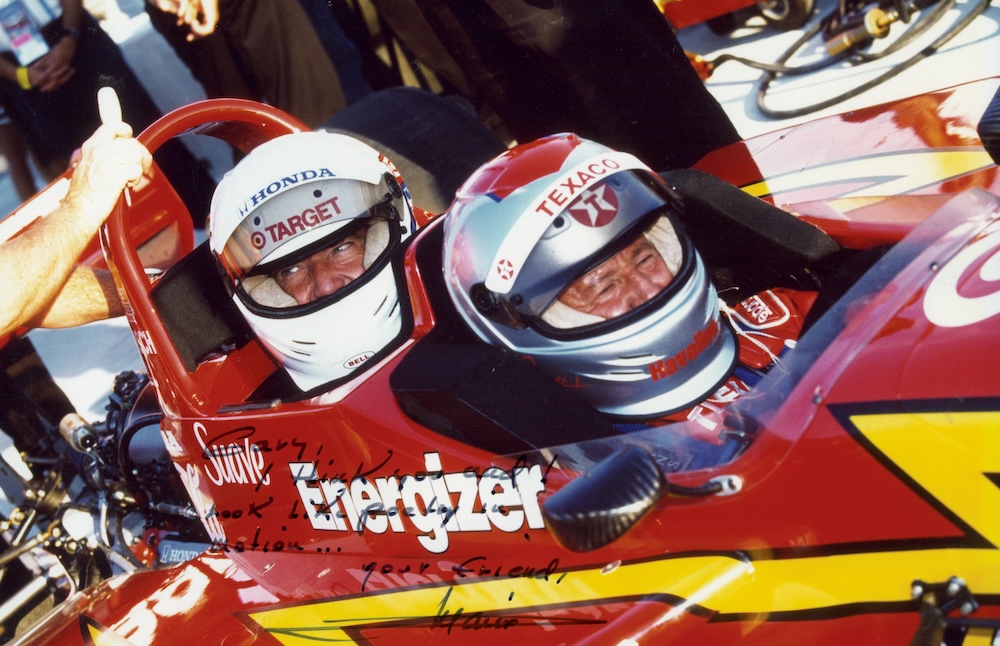
Racing icon Mario Andretti takes Gerould for a spin at the Target Grand Prix of Chicago in August 1999. (Courtesy of Gary Gerould)
Were you developing the equivalent of play-by-play skills covering motorsports?
There’s a bit of irony involved there, because there weren’t any play-by-play opportunities. The motorsports work, which was primarily what I was doing at NBC—I was a pit reporter type. I wasn’t in a host role in the early years. But that gradually began to expand. And the late [football play-by-play announcer] Charlie Jones was a fellow I worked with from time to time. He was basically the one who convinced NBC somewhere along the line to let me have a shot at doing some NFL football.
What do you remember about your first NFL call?
Baltimore was playing at Miami in the old Orange Bowl [stadium in 1982]. Jim Turner, who was a former kicker with the Broncos and the Jets, was the analyst. I was obviously very apprehensive, though I felt that I did a good job. But I remember how emotional I got after. I got back to the hotel and I just… I broke down. I sat there like a kid and just bawled, because I felt like I had achieved something. I felt like even if I never got to do it again, I proved to myself that at least on one occasion, I was good enough to work at a network level and call an NFL game. And that was huge.
You didn’t yet know there were dozens more NFL games to come.
I wasn’t anywhere near the top of the totem pole—I was number 5, 6, 7 or something like that, in terms of the broadcast pecking order. But every year leading up to the NFL season, NBC would assemble their NFL talent—their broadcasters, announcers, producers, directors—for three days at 30 Rock in New York City, and I was on that list. My wife and I always looked forward to it, because it was a chance to go to New York for a few days, go to Broadway shows in the evening, and be wined and dined at the network level.
One of the greatest compliments I ever, ever received—to this day, I cherish it—was from [broadcasting legend] Dick Enberg. I did a couple of events with him, and I remember him telling me, “I had a weekend off a couple of weeks back, and I was watching our NBC coverage of the NFL. And I’m telling you, you’re the best-kept secret that NBC has.” And I thought, “Wow.” I considered him one of the elite sports broadcasters of not only that era, but perhaps of all time. So coming from Dick Enberg, the compliment couldn’t have had any greater impact than it did.

Gerould and his wife, Marlene, with their daughter, Beth, at the wedding of their son, Bobby, and new daughter-in-law, Kim, at Faith Presbyterian Church in Greenhaven on Oct. 30, 1993 (Courtesy of Gary Gerould)
And then somewhere along the way, the NBA’s Kings come rolling into Sacramento from Kansas City.
It was January in 1985. Totally out of the blue. Phone rang one day, I picked it up. It was Greg “Dutch” Van Dusen: “Gary, it’s Dutch. I want to play ‘what if ’ with you.” I hadn’t talked to him probably since he had moved to Kansas City to be part of the Kings’ ownership group. [Van Dusen took over as executive vice president of the Kansas City Kings after fellow Sacramentans Joe Benvenuti, Gregg and Frank Lukenbill, Bob Cook, Steve Cippa and Frank McCormick purchased the team in 1983 before relocating it to the capital city two years later.] He said, “What if the Kings were to relocate and come to Sacramento? Would you be interested in being the radio play-by-play guy?” I said, “Are you kidding me?” And he said, “No, I’m serious.” I said, “Well, of course.” I was just blown away. I didn’t know how to grasp the idea of a professional sports franchise moving to Sacramento.
But you needed to essentially audition for the job?
I get [another] call from Dutch and he says, “OK, the Kings have got their final West Coast trip coming up. They’re going to be in L.A. to play the Lakers, and then up in Oakland to play the Warriors. We’d like you to go record those games so we can listen to it. The reason I’m calling you is because we want a local identity, and we want someone who we know is stable and who enjoys Sacramento and not someone who is using this job as a stepping stone.”
I take [my son] Bobby, who is in high school at that time, out of school, and we go to L.A. Bill Jones was the trainer—he handled all of the activities related to travel–and I touched base with him. And we get on the shuttle bus from the hotel to go to the Great Western Forum. We don’t know the protocols. We don’t know anything, but we know that [the situation] is kind of unusual, because we’re on this mini shuttle bus with [Kings players like] Reggie Theus, LaSalle Thompson, Eddie Johnson and Mike Woodson.
So we go to the Forum and we’re up there in the nosebleeds, two rows up above [the Lakers’ legendary play-by-play announcer] Chick Hearn. And I don’t know the [ins and outs of the] NBA, but Bobby is my stats man, and we call it. Then we do the same thing in Oakland. What I later found out was that those tapes went to [Kings general manager] Joe Axelson because he had the final say. As Joe drove from Kansas City to Sacramento once the transition was officially being made, he listened to those tapes. And I remember him telling me one time, in the early part of the season, “Kid, you were a hell of a lot better on those tapes than you had a right to be.” That’s how it began. And here we are now, 40 years later, and I’m one of the few people who’s had a chance to be with the Sacramento Kings from the get-go and who’s still involved with them.
Tell me about the first Sacramento Kings game on Oct. 25, 1985. That took place in the original Arco Arena, which I never got to see. [The temporary building on North Market Boulevard in Natomas was home to the Kings for their first three seasons in Sacramento.]
It was amazing, because Lukenbill and his [construction] company slapped up that warehouse structure and they did it in nine months, which was unheard of. It seated 10,333. There were four suites, one in each corner, and that was it. The locker rooms were about the size of a postage stamp. Bill Jones taped ankles in the hallway outside the locker room. The atmosphere was special. And that first game, I remember the first impression was pulling into the designated parking area behind the arena and hearing this regal music being piped to the parking lots, the fanfare—you immediately had the feeling of stepping into the royal kingdom. And the first night, many of the men wore tuxedos. A lot of people dressed formally for the first Kings’ game, and that was, you know, bizarre.
How’d the game go?
We were playing the L.A. Clippers, and we lost the game. I don’t remember the margin or how close it was. I remember that Derek Smith kicked our ass. [The guard scored 36 points in the Clippers’ 108-104 victory.] I also remember how starved people were for entertainment. There were only 10,000 fans jammed into this warehouse-like structure, and yet it was NBA basketball and it was legit. It was happening in Sacramento. It was really, really remarkable.

G-Man interviews Kings guard Reggie Theus at center court during opening night for the Sacramento Kings at the original Arco Arena on Oct. 25, 1985. (Courtesy of the Sacramento Kings)
And then the Kings moved to Arco II about a mile away, and that was a rather pastoral setting out in the open fields of Natomas, right?
Oh, yeah. It was built on the cheap. I think it was $40 million. By contrast, around that time, Milwaukee built a new home for the Bucks—the Bradley Center—and it was a $90 million structure with marble and wooden floors and all. But the old Arco [Arco II] had character. God, it had character. As far as the pastoral setting, Reggie Theus was a guy who loved to hunt. And he’d bring his shotgun in his Porsche Carrera, and he would hunt pheasants outside the arena sometimes.
That first Sacramento Kings team in 1985-86 went 37-45, but they made the playoffs. However, a lot of dry seasons followed that first one. How long was it before you called a team that was actually good?
Oh, my God—a lot of dry seasons. The second time they got to the playoffs as the Sacramento Kings was in 1996 and Mitch Richmond was the guy—an All-Star, “The Rock.” Michael Jordan had complimented him publicly on numerous occasions as the toughest guy that he had to face.
The Kings were in the No. 8 playoff spot. Seattle was No. 1. The Kings went to Seattle, split the two games there, and came home. I was doing television that year with [former Kings coach and GM turned broadcaster] Jerry Reynolds, and to this day, that first home playoff game is one of the most remarkable things that I can ever recall related to any professional sport. Talk about a magic moment before the game even started—the atmosphere, the buzz. Sacramento just went totally bonkers. Jerry and I were standing next to each other and we literally could barely hear each other, because for the minutes when the Kings first came onto the floor, 18 minutes or so before tipoff, the noise level never subsided. It was just insane. We were winning that game—No. 8 against No. 1—but we fell off in the fourth quarter and lost. Then Richmond got hurt in the next game, and without him, we ended up losing the series.
The next time the Kings made it to the playoffs was under Rick Adelman, when they had a run of eight straight years. [With Rick Adelman as head coach and Geoff Petrie as general manager, the Kings went to the playoffs every year from 1999 to 2006.]
When did you first start to notice the change? Was it the strike-shortened season [of 1998-99], when the Maloof family was taking control of the franchise?
Yeah, in 1999. I remember talking with other broadcasters at different points throughout those early years, when trying to get a winning season was just an insurmountable challenge. And I frequently said, “Man, I envy you from the standpoint that on any given night, your team’s going to be competitive. You’ve got a legitimate chance to win. That’s what I long for with this franchise.” I remember in that strike-shortened season, I was able to go to the Christmas get-together at ESPN’s headquarters in Bristol, [Connecticut], and that evening with the then-2,000-plus employees of ESPN, [reporter] David Aldridge said to me, “This kid Jason Williams is somebody you are going to love and you need to really keep an eye on. He’s going to be something, and he’s going to make your team so good and entertaining.” And of course, that resonated. Then I see [Williams], and at the time, they had Corliss Williamson, Chris Webber, Vlade [Divac] and Peja Stojaković. And Adelman. And that was the turnaround.
Rick Adelman is easily the Kings’ winningest coach. Can you talk about him a bit?
He was eccentric in a number of ways, and very private—an unusual dynamic for a head coach in a professional sport. But I had such respect for him, and he was such a player’s coach. And with the combination of him with Petrie, as the [1998-99] season began to evolve, we began to play this style of basketball that was so damn entertaining to watch. I remember thinking, “Are we on the cusp of finally getting to that point where we can go into any arena and feel like we’ve got a legitimate chance to win?” And sure enough, within a year or so, we were there. Man, there was such elation. That was a big, big change for the Sacramento Kings.
You knew that the Maloofs letting Adelman go in 2006 was a mistake.
I thought, “How do you let go of a coach who’s won over 400 games in the NBA?” He had eight years with this franchise, and they were in the playoffs every year he was here. What’s going to happen now? Much to our dismay, it wasn’t good. [The Kings have been to the playoffs only once in the 19 seasons since Adelman’s departure, and Mike Brown, who coached that 2022-23 playoff team, was fired at the end of 2024.]

Gary and Marlene, then both 21, following their wedding reception in Chico on Sept. 5, 1961 (Courtesy of Gary Gerould)
You’ve spent 40 seasons with the Kings and are starting your 41st. It’s a lot to condense, but do you have a favorite moment or two so far in all of this, aside from that first playoff home game?
I can probably come up with a handful, and they have different reasons. But when you mentioned that, two things immediately came to mind. The playoff series against the Lakers, the Mike Bibby game winner [in game 5 of the 2002 Western Conference finals]. It was on a curl on the right side, in rhythm. Nine seconds to go, hits it. The Kings take a one-point lead, but Kobe still has a chance. The Kings get the stop at the other end and they win the game, which gives them control of the series. That is huge. I mean, that will probably never go away as a great, great moment. Then there was the time the Kings were down 35 in the third quarter in Chicago and came back to win. [The Kings rallied to beat the Bulls in December 2009. The game remains tied for the second-largest comeback in NBA history.] That was unbelievable.
On the flip side, how did you stay positive during the long stretches when the team wasn’t playing well? That had to be disorienting.
Yeah, sure, it’s frustrating when you don’t win 30 games in a season. It can be demoralizing, but there was always something in the back of my mind that said, “Don’t let that impact how you do your job. Try to find something positive even if you’re getting blown out.” And Lord knows, we got blown out big time at different times. But I would try to find something to be positive about, so I tried to play off of that. But to be honest—that’s also always been in my mind. You can’t fool your audience, even if it’s radio and they can’t see what’s happening. They’re smart. They know what’s going on when you’re getting whooped night after night after night. So I’ve never been one to disguise it. You just have to find a way to roll with it.
That’s been one of the larger challenges, I would say, over the 40 years of broadcasting the Sacramento Kings—and certainly when it looked like they were going to move the franchise to Seattle. The last few weeks of that [2012-13] season were probably the hardest of any time, because I would literally talk to myself on the way to the arena saying, “Don’t let this drag you down.” And I knew that if the franchise moved, I wasn’t going to be moving with it.
Why is that?
Well, for a couple of reasons, but [primarily] our daughter’s illness. She lived with us, and had always lived with us. Beth had health problems from the time she was in high school. [As a teenager, Beth was diagnosed with kidney disease, and as an adult, with lupus. She suffered a severe stroke in January 2020 and died nearly three months later at the age of 57.] She was a great, great fan of the Kings. Beth, Bob and Marlene went to every game.
I still cringe when I think about how close we came to losing the franchise and what it would have meant. To me, it relates to the young fans. You look at their exuberance, their passion, and you see that the coming generation of young fans is not [potentially] going to have the privilege of going to a Kings game with Mom and Dad or with their aunt and uncle or with Grandma and Grandpa. That was the thing that I just couldn’t shake; that was the thing that hurt. Then I thought about the ticket takers, the ushers, the security people. How were they going to survive if this franchise moved? I’m just a softy in so many respects, and my heart went out to those people. God, it was such a difficult time.

The Kings surprise Gerould with the DPOG (Defensive Player of the Game) chain, a commemorative jersey and a signed basketball after the veteran broadcaster called his 3,000th game for the team on Feb. 26, 2023. (Courtesy of Gary Gerould)
Do you still keep things open-ended with respect to your Kings career?
In our family, the understanding has always been that as long as you’re healthy, as long as it’s still fun, and as long as I still feel like I’m wanted—those are the parameters that guide me in terms of the future. I’m not naive in the sense that I know something could happen to me and maybe I won’t be capable of broadcasting anymore. I’m at that age where those things happen. And I have to accept that. But I’ve always been a person who believes you deal with the cards that have been dealt to you. And you can moan and groan about those cards, but it doesn’t accomplish a damn thing. You’ve got to accept it, adapt to it, and go with it.
And you’re still doing it.
Well, I am, and I’m so doggone fortunate that I get a chance at my age to do it. I still think the passion and the fire burns the way it has in the past, and I still think that I’m pretty darn good at what I do. But there are times when I know things are different. I know that I have a more difficult time adapting to these faraway broadcast vantage points that have made the job so challenging over the last 20 years. [Most NBA teams have relocated radio broadcasters from courtside to high up in their arenas in order to sell more premium seats.] You want to inform, you want to entertain as best you can, and you want to be able to do it to a certain standard.
But do I still get excited about [each new season]? Yes. It’s a time of perennial optimism. And you wonder, OK, how is this group? Are they going to take a step forward in terms of their chemistry? Are they going to be better? Did they learn from the mistakes of last year? Is [Domantas] Sabonis still capable of controlling a game? Is Zach LaVine able to use his athleticism and his quick second step in different ways that can help this team win more games than it loses? That’s what this time is for. It’s a time for new evaluation and new commitment and new perseverance. And there’s optimism that goes with that.