The Ice Blocks Cometh
It is, by all appearances, an urban utopia. Come this spring, more than 500 people will work there, more than 200 will live there, and thousands more will dine and shop there. Its innovative tenant mix ranges from an insanely popular “doughnuterie” to a gourmet dog food shop and an Internet-based boutique where you don’t leave with the clothes you buy. And this bustling village within a city—elevated by art and cutting-edge architecture—all exists within a two-block span in the coolest district in town. Could the Ice Blocks be the new model for modern living in Sacramento?

S
idewalks wide enough to host pop-up concerts, enchantingly intimate urban vistas meandering down every alleyway, storefronts full of jewel-toned textiles, colorful pastries and retro-rustic outdoor gear, floor-to-ceiling windows offering glimpses into airy apartments with spiral staircases and gallery-white walls, locals with laptops lounging in open courtyards as if they were in their living rooms, sipping on cold-pressed green juice. This is what the post-recession renaissance looks like at the Ice Blocks, that stretch of the burgeoning R Street Corridor between 16th and 18th streets that has been dreamed of and struggled over ever since, well, since before that barista who just sold you your pour-over was in diapers.
A walk down this strip alongside Michael Heller gives you a developer’s-eye view of Sacramento’s newest, most design-forward neighborhood. With the aid of his X-ray vision, you can appreciate the good bones, the historical nuances and the many details that would go unnoticed by most, like the bollards he had sunk into the pavement that can be raised to block off the street for events—no ugly temporary barriers here—or the doodles by artist Gale Hart that enliven unremarkable objects like electrical boxes and parking lot elevator banks, or the textured crosswalk pads Heller had the City change from canary yellow to a more aesthetically integrated dusty red.
“When I kick the bucket, if you choose to write a blurb about me,” he says, grinning sunnily and spreading his arms wide, “you’ve gotta say, ‘Mike Heller is the one who got rid of that f–king yellow.’ ”

The second-story deck at Ice House, which is open to residents of the apartment complex, is made for lounging, with a reflecting pool, a fire pit and Adirondack chairs. (Photo by Chad Davies)
When Heller drops an F-bomb, it’s always with great cheer and gusto. Wearing a polo shirt with sunglasses hanging from the neckline, the sandy-haired 54-year-old may not look much like a rebel or an artiste, but make no mistake: He’s as nonconformist and creative as any of the visionary designers, artists and entrepreneurs he has supported over the years.
Either a late baby boomer or an early Gen Xer depending on where you draw the line, Heller is one of those people who doesn’t belong culturally to any particular generation or movement, just an individualist who has found his groove by speaking truth to power, fighting the good fights, sweating all the small stuff and never giving up. Not a single blade of grass grows under Heller’s feet, not today, with the finishing touches going on a project years in the making that people in the know say shouldn’t even have been possible.
*****
The neighborhood tour starts on the southeast corner of 17th and R. “This is called the Ice Sheds for these shed-like buildings, which are really just modern barns,” Heller says. The one- and two-story retail and office complex—where his development company, Heller Pacific, is now headquartered, overlooking the “shed” that houses the new outpost of Bay Area stalwart Philz Coffee—is physically the smallest of the three blocks, but it makes a fierce architectural statement. A series of corrugated metal structures interwoven by paths, planter boxes and intimate seating areas, the block brings Sacramento something it hasn’t much enjoyed, which is public outdoor space that feels sheltered and habitable. If you’ve ever shied away from sidewalk seating because of the noise and the not-so-ambient belching of automotive exhaust right at lung level, the Ice Sheds is a welcome oasis, with all its gathering spots—and they are many—either thoughtfully set back or perched a few feet above the fray.
In the line of shops open, or about to, at the Ice Sheds in early October, a sign announcing Healthy Hounds Kitchen hangs in the windows of one retail bay—the high-end dog food retailer co-owned by Kru’s chef-owner Billy Ngo is preparing to open its latest store next to the future home of Milk Money, where pastry chef Rebecka Smith will be putting out a curated selection of doughnuts every day. There’s only one empty space, and Heller hasn’t quite decided its fate. “I don’t need more food here,” he says, “So I think this will probably be a maker type of space. I might take a flyer on it as long as it has a simpatico vibe. We have a lot of penniless, inexperienced dreamers.”

Ice Blocks developer Michael Heller in front of the preserved historic Orchard Supply Co. façade (Photo by Jeremy Sykes)
“Dreamers” is one of Heller’s favorite words. He uses it to describe the artists, entrepreneurs, restaurateurs and designers whose eyes may be bigger than their wallets, but whose ear for the zeitgeist is perfectly on pitch, a quality Heller understands to be the secret sauce to making a neighborhood authentic, as opposed to manufactured.
At the other end of the Ice Sheds, unisex barbershop Bishops sits next to outdoor apparel start-up All Good. “I was watching a Cleveland Cavaliers basketball game,” Heller says, gushing like a proud papa, “and Lebron James comes out afterward wearing an All Good cap. These guys are brilliant. Creative. And they do really cool adventure trips. They’re like Patagonia when they first started working out of a garage.”
Heller first attempted to lure Bishops to town a little over 10 years ago when his mixed-use MARRS building opened at 20th Street between K and J in midtown, sparking an area revival. At the time, the Portland-based company, which was early to the hipster barbershop concept, couldn’t see its way to Sacramento. And until recently, neither could upstart All Good—the hot local clothier opened its first retail outlet in, wait for it, Portland. Heller has now flipped that script, bringing it all home, and then some.
The two big sheds lining the main drag are occupied on one side by Philz and on the other by Beast & Bounty, a wood-fire-focused restaurant with a dual-column menu catering to carnivores and the herbivores who love them, from the team behind LowBrau and Block Butcher Bar, two wildly popular dining spots at MARRS that have come to represent the crux of the midtown experience for a lot of new-wave urbanites.
MARRS (which stands for Midtown Art Retail Restaurant Scene) not only did well by its tenants, it also energized the entire street, a stretch where farmers’ markets and rollicking block parties are now the norm. Heller intends the same for the Ice Sheds.
“Dreamers” is one of Michael Heller’s favorite words. The Ice Blocks developer uses it to describe those whose eyes may be bigger than their wallets, but whose ear for the zeitgeist is perfectly on pitch, a quality he understands to be the secret sauce to making a neighborhood authentic.
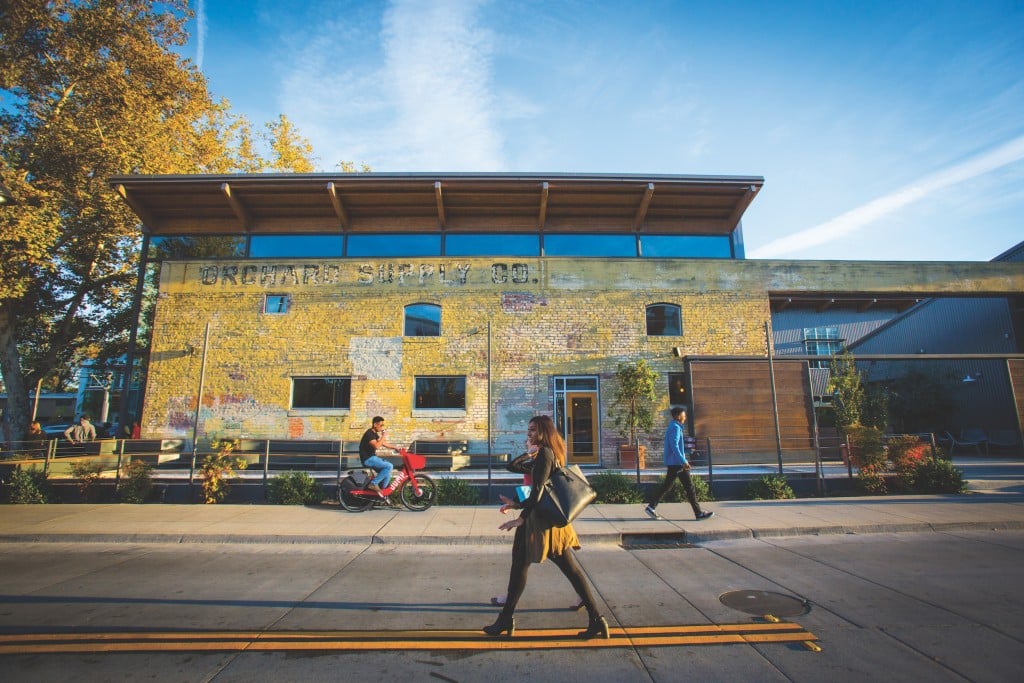
At night, the sheds’ architectural beauty gets a second shot of adrenaline. The 1920s-era rough brick façade that once fronted the Orchard Supply Co. was preserved at great effort and at even greater expense (more on that later) by local architect Ron Vrilakas, who earned his placemaking cred with a series of mixed-use success stories he designed and developed in Oak Park’s Broadway Triangle district. Vrilakas, at Heller’s instruction, left the façade untouched, setting it off by making it seem to float unattached. New clerestory windows raise the slanted roofline, allowing sunlight to cascade into the spaces facing R Street occupied by Philz and Beast & Bounty during the day and creating a warm glow at night, emphasizing the wall’s tenuous hold on space and time—it’s like a magic portal crossing between history and modernity.
Even the parking lot is strategic and thoughtful. Yes, half the block is a leafy and verdant garden spot for cars, but it too has an ulterior motive for being. “The parking lot was set up for food trucks,” Heller explains. “We put bathrooms here, and all the things they need to operate.” He points out a bare patch among the parking lot’s lush landscaping that is actually wired as a stage area. “We’ll get food trucks and music [to put on] a good party,” he adds. And the lot is already permitted for mid-rise housing to potentially echo the Ice House, the retail/residential block across the main drag, and provide new homes to appeal to the coders, designers and other creative class members who will be working in the offices in the other building, the Ice Shops.
Crossing the street to continue the tour, Heller pauses and gestures across the four corners of the intersection where the three Ice Blocks—Ice Sheds, Ice House and Ice Shops—meet (the fourth is currently an empty lot owned by a different company). “I didn’t want it to look like all three blocks were the same thing, so they all have their own design/build teams,” he says. “I’m something of a hypermodernist, but we tempered the DNA to fit into the context of these blocks. So even though they are new buildings, they look like they’ve been here a long time.”

Appointing three different design/build teams to work on the project ensured that the Ice Blocks would have the varied texture of an urban landscape, rather than the homogeneity of a single development. (Rendering courtesy of Heller Pacific)
Midtown-based Vrilakas Groen Architects designed both the Ice Sheds and Ice House, which were built by A.P. Thomas Construction and DavisReed Construction, respectively, while Stephen Guest of RMW Architecture & Interiors designed the Ice Shops, built by Ascent Builders.
And if the three blocks aren’t siblings, they’re definitely cousins. Heller notes that “all three have a different way of articulating metal cladding—different colors, different corrugations—but they all have it. It ties the blocks together.”
The Ice Blocks does feel organically crafted, and like all great urban streetscapes, inevitable, but it could have gone a different way. Heller has curated the mix of retail tenants with great care, balancing his commitment to regional entrepreneurs with an eye toward bringing in global brands that will give the area an infusion of worldliness. It took discipline, and turning away prospective tenants other developers would have seen as major coups.
“There was a strong temptation to turn this whole block into an entertainment project,” Heller says. “One of the best concert promoters anywhere came to me early, wanting to do a 2,500-seat venue, which was tempting. They’re real. They’re mature people. I probably would’ve gotten a [steady] rent check.”
The Ice Blocks does feel organically crafted, and like all great urban streetscapes, inevitable, but it could have gone a different way. Heller has curated the mix of retail tenants with great care, balancing his commitment to regional entrepreneurs with an eye toward bringing in global brands that will give the area an infusion of worldliness.
He pauses, a moment of silence for the ghosts of rent checks passed on. “But I knew that if we did that, all these new spaces would be more bars and restaurants,” he says, wincing at the idea. “I’ve been doing this for 22 years, and I’ve done more than my fair share of bars and restaurants, but that’s not what we need. If we want to elevate this city, it’s not with more bars and restaurants. So I said no to those guys—which was a gutsy move—in the hope of attracting retail, retail, retail.” The urban experience isn’t complete, he explains, unless you can have lunch, then do a little shopping—a row of bars and restaurants may be a destination, but Heller isn’t creating a place to go once a month to be entertained; he’s creating a walkable neighborhood where you can live, work, grab a bite and if you’d like, “buy a shirt.”
The gamble paid off. The small-scale spaces in the Ice Sheds are dominated by boutiques, while the retail level of the other blocks is home to some household names even Heller seems a bit shocked to have landed.
The southwest corner of the Ice Blocks is anchored by a palatial West Elm store, where Ice House denizens—and their parents in Land Park—can pick up glass globe chandeliers, along with crushed velvet throw cushions and sectional sofas to throw them upon. To the east, gourmet salad and sandwich chain Mendocino Farms is scheduled to open in December, while a jaunty strip just beyond features SoCal-based Pressed Juicery, a Pure Barre exercise franchise (which offers ballet-inspired workouts), eyeglass phenom Warby Parker, and Bonobos, a formerly online-only clothier that made a name by wooing techies into a stealthily fashionable upgrade from Dockers. Pioneers of a new hybrid online/brick-and-mortar retail model, Bonobos’ neatly appointed shop carries only samples in various sizes, and your purchase arrives on your doorstep the next morning.
As delighted as he is at how things are shaping up, Heller also feels the pressure. “Now Sacramento has to make it a success,” he says. “I’m not kidding. You name a retailer, they’re all watching. If these guys don’t make it, don’t think we’ll see great retail come here for a very long time. Sacramento won’t get a [downtown] Apple store. We won’t get any of those, which would suck if what we’re all striving for is a more sophisticated city.”

A large wall of the old Orchard Supply Co. building—seen here from inside Beast & Bounty—is the last remaining element of the original structure and lends an industrial-chic vibe to the new restaurant. (Photo by Marc Thomas Kallweit)
The bones of sophistication are there. Along this row of storefronts is where the generous sidewalks beg for a street scene. Heller deliberately created these pedestrian buffers with street activation in mind, installing retractable bollards at the ends of every block too, so portions could be closed to automobile traffic for events. What kind of events? Well, if you’re a dreamer, call Heller Pacific up and suggest one.
“Who has a good idea, and who wants to own it? I’ll give you the opportunity for free to come do it,” he says, referring to pop-up shops and street programming like shows and performances. “There are so many ideas of things to do when you see the platform here. We’re just an eight-person company. We don’t have [enough] hours in the day, so we just send the word out to the creative gods, and then these young people come to us and say, ‘Hey, can we do a pop-up?’ If they’re cool and they have insurance I say, ‘Yeah,’ ” Heller asserts.
*****
Floating above the ground-floor hustle and bustle, Ice House’s central courtyard is an oasis of calm, with a reflecting pool, a cozy fire pit, a barbecue area, sofa groupings and an adjoining TV room boasting a restful mid-century vibe, all of which feels like it belongs on the grounds of a day spa in Calistoga. Heller originally envisioned a swimming pool and a sports-themed lounge for the space. “I got out over my skis,” he says. “Then I started thinking, ‘Who’s that going to attract? These guys with barbed-wire [tattooed] muscles partying in the bushes?’ So I completely redesigned it.”
All but a few of the 142 market-rate units are rented out, mostly to a demographic Heller describes as “a lot of young people with good jobs who are making some dough and want to live the dream,” but also to a handful of retirees who appreciate being able to walk to coffee, dinner and Safeway. A small but high-ceilinged one-bedroom loft apartment rents for approximately $2,000.
That price point is probably right in your sweet spot if you’re an employee of the tech firms soon to move into the last (but far from least) block to be completed, the Ice Shops, which is not so much a building as Heller’s Mount Everest, a challenge that at many times along the route seemed insurmountable.

The Ice Shops building, constructed using heavy timber, provides 88,000 square feet of office space. (Photo by Jeremy Sykes)
The story, as architect and developer Ron Vrilakas tells it, began back in the mid 1990s, when the group of buildings comprising the Crystal Ice and Cold Storage plant belonged to real estate developer Angelo Tsakopoulos, whose intent was to erect yet another cluster of faceless, monolithic concrete and glass barracks to provide overflow office acreage to state offices. “If you look around Sacramento,” Vrilakas says, “most of the ugly stuff people hate is State of California’s back offices.”
Neighborhood activists, including Vrilakas, fought tooth and nail for years for a different vision of human-scaled, mixed-use development that would transform the area bordering downtown and midtown into a vibrant urban district. “It was really a divisive issue in Sacramento at the time,” says Vrilakas.
At a city council showdown in 1996, livability prevailed, paving the way for the 54-block area we now call the R Street Corridor. It would be almost another two decades before much of anything stirred at the Ice Blocks.
“It was an old cold storage facility that had been closed since 1978, so it was literally falling apart,” says Mark Friedman, who acquired the property in 2005. “But it had great bones.” The developer longed to turn the historic Crystal Ice property, built in the 1920s and consisting of two contiguous warehouse blocks (Heller added the facing block containing the equally dilapidated and historic Orchard Supply Co. building when he assumed leadership of the project), into an urban renewal showcase—picture a steampunk gem fortified with fresh steel and glass, timbers scraped clean and concrete polished. But when the time came to pull the trigger, Friedman found himself committed to another catalytic undertaking, the Golden 1 Center. He turned to Heller, a good friend with whom he had previously collaborated on various urban projects, and together they decided that Heller would take the lead on the R Street endeavor, with Friedman staying on as an investor (Sacramento Republic FC chairman and CEO Kevin Nagle is also an investor).

At the Ice Sheds, the massive barn doors that lead to a public courtyard can be closed at night to create an intimate party patio. (Photo by Chad Davies)
“When I got involved in doing the arena, it became clear that the city was about to go through a renaissance. It was the right time to develop the Ice Blocks, but I didn’t have the bandwidth to do both, and I couldn’t think of anybody better than Mike,” Friedman says. “He’s the best developer I’ve ever come across, at every level. He’s got an impeccable aesthetic sense. He’s a tough negotiator but super fair, and he’s passionately invested in the work.”
Heller shared Friedman’s vision even as he put his own spin on it. “I walked through those buildings hundreds of times,” Heller says of the original Crystal Ice warehouse site. “I couldn’t wait to give tours because I was so fired up about trying to preserve these buildings. It was a passionate time of my life.”
Strategic demolition to clear the path for reconstruction had barely begun in late 2015 when Heller got a call at 5 a.m. one Saturday at the beginning of November. There’s a fire. You’d better get down here. Within hours, the Crystal Ice block had burned beyond repair. Investigators never found the exact cause of the fire, but there is no indication that it was anything other than a gut-wrenching mishap.
“We were all just in a state of shock. Two hundred people called me or emailed me, like there had been a death in the family,” Heller says. “I mean, it was a community asset. When I realized people cared that deeply, I thought, ‘Now we can’t fail.’ ”
So he rallied the troops. “I said, ‘We can feel sorry for ourselves for one week. That’s it, because we got a lot of work to do, or at least I know I do, because I can’t quit. So, one week to feel sh-tty.’ ” When the team reconvened, Heller offered to let any of the architects, developers or construction partners bail, as the workload and timeline would now be extended indefinitely. None did, and that sense of commitment in turn helped galvanize Heller’s resolve.
Heller got a call at 5 a.m. one Saturday. There’s a fire. You’d better get down here. Within hours, the Crystal Ice block had burned beyond repair. “Two hundred people called me or emailed me, like there had been a death in the family,” Heller says. “When I realized people cared that deeply, I thought, ‘Now we can’t fail.’ ”
The following January, the developer flew his design team up to Portland for inspiration. “My allies, all my buddies up there, felt very badly for us, and they had [arranged] a tour of all the coolest new things happening in Portland,” Heller says. “On the first morning of the first day, they took us to see the first that I had seen of a heavy-timber structural wood office building. There was no metal or concrete. This was the new rage in the structural [engineering] world. I looked at it, and I went, ‘Let’s do this!’ ”
In the meantime, architect Vrilakas remembers, the total loss of the Crystal Ice warehouse block and the historic atmosphere it lent the development inspired Heller to double down on rescuing the charmingly distressed but structurally unstable Orchard Supply Co. wall across the street in the Ice Sheds, which remained undamaged. “Saving the wall was technically challenging,” Vrilakas says. “We had to find a way to prop it up and build new buildings around it, and then it had to be reinforced because it was crumbling. The economic forces were saying it was too expensive. But the emotional forces… Mike’s not going to wave the white flag because he’s tired.”
Mark Friedman emphasizes “how extraordinary it was for Mike to not only pick up the pieces, but to come back with something that was better than what he originally envisioned. The original idea was spectacular, but what he selected has many of the same aesthetic elements that were so appealing about the original—the warm wooden ceilings, the honest, muscular construction style.”
*****
With the Ice Sheds set to embody the neighborhood’s history, Heller hired Sacramento architect Stephen Guest to design an entirely new cutting-edge building for the burned-down Crystal Ice block and renamed the area Ice Shops. A soaring wall of glass faces north, toward R Street, the better for pedestrians to appreciate the view inside to the exposed structure, where expanses of rough, knotty Douglas fir, laminated into beams, girders and columns, support wide-open spaces with an indoor-outdoor feel. At a smaller scale, the structure would be reminiscent of a cozy yet progressive modernist vacation home you might see in the pages of Sunset or Dwell, but at this massive scale, the soft wood and expansive interior take on a startling grandeur. It’s thrilling architecture, at once intimate and uplifting.
Stephen Guest, who also designed the MARRS refit, says that the Ice Shops building also represents a new mode of climate-friendly construction. “When you use wood in this manner, it’s equal to or stronger than steel, and as long as it’s sustainably harvested, it’s a great product. A lot of the timber in the building is industrial grade, and we actually thought it looked more interesting with the knots and gaps.” The construction style is, interestingly enough, as Guest points out, remarkably fire resistant.
And tenants have gravitated, although Heller’s lease negotiations for the right to hang out one’s shingle in the breathtaking new marvel does not include the right to hang curtains or tchotchkes, or even to wall off private offices against the dramatic sweep of glass—the glass façade is to be kept clear, preserving the full effect of the structure’s relationship with the outdoors, and keeping an iconic building iconic for everyone, inside and out. “The light is very sophisticated on this project,” says Heller. “There’s a lot of indirect light and ambient light, and it’s just frickin’ beautiful.”
Did a few prospective tenants balk at being told what they could and couldn’t do with their premium office space? Of course, Heller says. “The owners would get all pissy, but then they’d hand it off to their designers, who would say, ‘That’s so cool! We can’t wait to get going!’ ” He laughs and shrugs. “I’m being a little bit of a jerk,” he adds, “but I know that on beautiful nights, people will take walks down here, and if that’s the case, I want this building to be a real example of how we care about architecture. So on R Street, we want views from the street looking up into the wood and cool lighting.”
Heller is somewhat of a Steve Jobs-ian control freak when it comes to design. “I believe that ultimately success is in the details, and that ethic is in short supply in Sacramento, so I respect that about Mike,” Vrilakas says. “Our office works that way, and usually we’re having to pull clients in that direction. But when we worked with Mike, he was trying to pull us to a higher level. It was an interesting turning of the tables for us. It’s challenging working with him, but that’s why it’s great.”

The many faces, spaces and places of the Ice Blocks include everything from a gourmet dog food shop and a hip-hop doughnuterie to chic boutiques and artful streetscapes. (Photos: From top, left to right: Jeremy Sykes. Marc Foster. Bernard Andre. Daniel Xaysongkham. Blackfield Media. Brian Barneclo. Curtis Yee. Ran Alberto. David Rosales. Vanessa Chaverri. Courtesy of the Ice Blocks. Chris Ouchida.)
Heller has a long history of holding his tenants to ideals that can be challenging. When leasing out the MARRS building, he required restaurants to stay open until at least 9 or 10 p.m. on weeknights and 1 a.m. on weekends in an effort to encourage a mindset in midtown that he hoped would be infectious. But the MARRS building occupied only one side of one block and didn’t include any residential component. With the Ice Blocks, Heller has the opportunity to indulge his inner city planner and create the most complete manifestation of his urban ideal—a living, breathing diorama of the kind of Sacramento that he personally wants to experience.
High-profile tenants moving into the Ice Shops include EA Capital Games—which is relocating (and dramatically expanding) from their current digs in midtown—the Amsterdam-based co-working firm Spaces and the global consulting giant Accenture. “They’re coming here with their think tank of dreamer cats,” Heller says. “By May we’ll have 500 people working here.”
That’s good news for Device Brewing Company, the local operation that has opened a shiny and bustling new taproom downstairs. Or bad news, as Device can hardly handle more business, already packed to the considerably lofty rafters every night, despite being in the back of the building along an alleyway.
But oh, what an alley. Not being one to leave any detail unvarnished, Heller wanted to make the back of his building as active as its front, so the alley side is also lined with retail spaces housing Device, Title Boxing and a soon-to-open cozy, clubby whiskey bar with no windows named Frank, which Heller calls Mad Men-esque.
To elevate the environment, Heller decided that the long, blank rear wall of a building owned by another company that faces this stretch of storefronts across the alley needed a mural to provide a sense of place and visual dynamism. After two years of searching, he commissioned San Francisco artist Brian Barneclo, who rendered a bebop-inspired mid-century modern masterpiece that lights up the drab alley with allusions to our rivers, the Kings and our identity as the City of Trees. “I spent $30,000 on somebody else’s property,” Heller quips.

The residential portion of the complex, called the Ice House, contains 142 units. A one-bedroom loft apartment rents for about $2,000 a month. (Photo by Chad Davies)
The Ice Blocks is dotted with public art, thanks to Heller’s interventions. In the immediate aftermath of the fire, he had the presence of mind to pick through the rubble and select a few important remnants he thought worth rescuing, expenses be damned. He saved a chunk of original concrete with the words “Crystal Ice and Cold Storage,” which now decorates the front of the Ice Shops, right at eye level. He also saved an assortment of vintage transformer boxes, which local artist Gale Hart arranged into a wall installation inside the office building’s second-floor elevator lobby. And he inexplicably (at the time) had an enormous, four-foot-diameter boiler pipe removed and trucked away.
“It was 30 feet long and weighed 20,000 pounds,” Heller said. “I hired a huge crane and a truck and rented a space in West Sacramento to store what most people would have thrown away.”
Eventually he found a metal artist he liked, Marc Foster, who sheared off the two ends, with their perforated filters, and turned them into housings for two spotlights that now sit on the corner of 17th and R streets. They make for an exciting focal point for the street corner, whether you know their origin story or not, but Heller is as excited about what the artist did with the rest of the giant pipe.
“I get no credit for this,” he enthuses, whipping out his phone to look for pictures. “But when you cut it the way that he did, it created these metal [circular sections] that unto themselves are fabulous sculptures.”
And that’s just the story of one piece of art on one street corner. When you traipse from Philz Coffee to Pure Barre to West Elm on a sunny Saturday, just know that every detail of what you see has a similar origin story. Even a pair of humble trash bins in the Ice House were inspired by a trip to Copenhagen. This is definitely Mr. Heller’s Neighborhood, and one of the hat tricks he’s pulled off is to make his tenants and collaborators feel like they own the neighborhood too.
Michael Hargis, proprietor of Beast & Bounty and Milk Money, remembers Heller going above and beyond the role of landlord when he was one of those “dreamers” incubating LowBrau as an anchor tenant for the MARRS building. “We came to Mike with a pretty solid concept, but there were some holes,” Hargis says. “He acted as a mentor and a coach. We were getting together once a week to go over fundraising, who we were targeting, budgets, things like that.”

A bocce ball court offers guests of Beast & Bounty that rare opportunity to indulge in a little urbane outdoor recreation in the central city. (Photo by Chad Davies)
At the Ice Blocks, Hargis feels like he’s kicking it at home with his best buddies. “Jason Maggio, who owns All Good, is a longtime friend, and then Ken [Anthony] over at Device Brewing is another good friend of mine. I think Mike really took into consideration that he was building a village here,” Hargis says. “I really like that there is a community of business owners coming together, and we’re going to be able to do some creative programming: design markets, farmers’ markets, movie nights. We’re just going to get as creative as we possibly can.”
Vrilakas, who designed the building that houses Hargis’ restaurant, also shares that sense of ownership and pride, and believes his fellow Sacramentans should as well. “I think what we all tried to achieve with the Ice Blocks is that it would be a project people from other cities would come take a look at and learn from. And we achieved that. I can’t think of another developer who could have done what Heller did.”
The Ice Blocks isn’t in Heller’s rearview window just yet, not with details to polish and spaces to rent, even as the neighborhood takes on a life of its own. But as the intense period of creation winds down, he is starting to make noise about this one being his last hurrah, about how he’d love to move on and do something else with his life once the Big One is done. Take that talk with a grain of salt, because another thing you learn from spending time with Heller is that he’s a serial monogamist when it comes to development projects. He loves the one he’s with truly, madly and deeply, like there’ll never be another.
But there is another, and she’s a beaut. The Tribute Building, still on the drawing board, is the brainchild of Heller—whose father, Michael Heller Sr., was a longtime local contractor and modern architecture aficionado—and his good friend, gallerist Paul Thiebaud, son of legendary painter Wayne Thiebaud. The senior Heller and Thiebaud collaborated on the SMUD building, a mid-mo landmark that is as stunningly contemporary today as the day it opened in 1960. Wayne Thiebaud’s mosaic frieze, titled Water City, nearly encircles the base of the structure, which is currently undergoing a thorough restoration.
Mike and Paul originally planned The Tribute Building to honor their fathers, who had contributed so much inspiration and support to their sons’ careers, shortly after the passing of Heller Sr. in October 2007. A cool, modernist edifice fronted by a spectacular multistory mural reproduction of one of Wayne Thiebaud’s iconic Delta landscapes, the Tribute was envisioned as a structure to make the world’s architectural community sit up and take notice of the deep, multigenerational talent pool in Sacramento. A site was secured for the mixed-use venture at 20th and Capitol, but the project stalled when Paul died of cancer in 2010 at the age of 49 (Wayne Thiebaud is still painting at 98). The labor of love took a back seat to grief—for a while.
Now this long-postponed vision, reimagined to pay tribute to Paul as well, may finally be ripe for realization. It’s clear that only a project so steeped in love, family, art and architecture (all words describing variations on a theme for Heller) could hope to feed the creative void that will surely be left once the last square foot of the Ice Blocks is rented, the last bit of public art installed, and buskers are finally entertaining happy, hungry shoppers, most of whom will never know there was ever a man behind a curtain engineering their perfect urban experience.
“It’s not about me,” Heller says, surveying his—quite literal—corner of the world before heading back to his office. “It’s not about the Ice Blocks. It’s about Sacramento.”